
August 2026
Coral
Coral in all its allure, the gem of the sea

Designed by Janice Grzyb
In this month’s dispatch, we will be diving into the depths of coral's history in jewelry, and the environmental implications of its popularity today. Most people can conjure an image of coral easily, a gem so distinct its color is homonymous. Known mostly for its warm, orangey hues, it can also range from a deep red to a light pink. For all its lively color, coral is actually a skeleton from marine corals that live in rocky crevices far below the sea. Their signature color comes from a bone structure that includes carotenoid pigments. It’s one of the few “organic gems” which unlike mineral stones are derived from once living plants or animals. They share this title alongside pearls, jet, amber, and petrified wood.

Designed by Janice Grzyb

Rattle, Whistle, and Bells, Nicholas Roosevelt, American, Gold and Coral
Coral has been used in jewelry dating back to ancient Roman times, with the Mediterranean being the primary source for precious red coral still to this day. The Romans believed that coral had the mystical property of warding off evil. Strings of coral beads were gifted to infants and children as talismans of protection. Coral, with a hardness of 3.5 on the Mohs scale is considered relatively soft, making it easy to carve and shape.
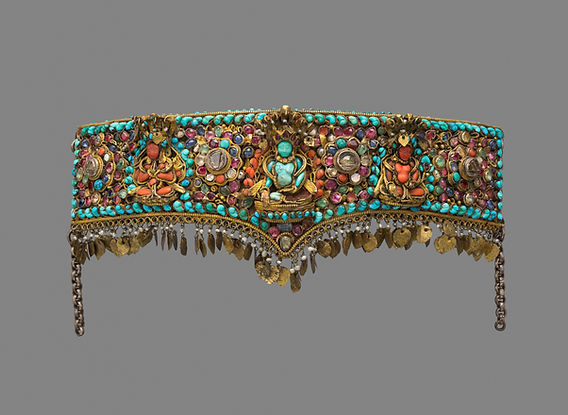
Forehead Ornament for a Deity, 17th-19th ct, Newari, Gilt Silver, Coral, Other Gems
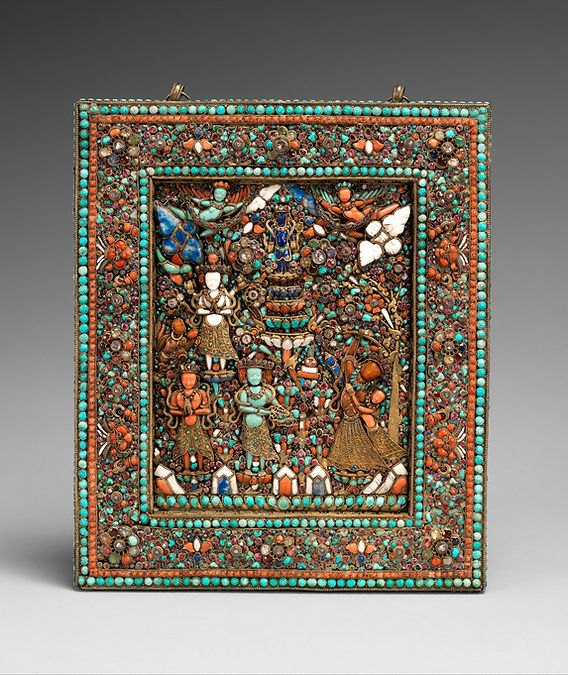
The Birth of the Buddha, 18th-19th ct Nepal, Mosaic of multiple gems including coral
During the 17th and 19th century, aristocratic young men of Europe were encouraged to traverse the continent as an informal element of their education in hopes of curating a sense of worldliness. An emphasis on classical cultures put Italy as the focal point of these travels, and jewelry often made it back home as a souvenir. Coral relics were reintroduced to the mainstream and during the Victorian era was elevated and worn by upper class nobility even worn by Queen Victoria herself.


Earring (Part of Parure), ca. 1860, Italy, Coral and Gold
Coral remains a staple in jewelry being utilized by a multitude of cultures around the globe. While red coral from the Mediterranean is prized, it’s hardly the only type of coral on the market. Coral can be found off Hawaii, Cape Verde, Portugal, as well as surrounding Asia in the Paciffic. Japanese “Tosa” coral is revered for its deep blood red color. Other varieties of coral include bamboo coral which is naturally pale and the rare black coral. Other less valuable coral helps satiate demand for the gem, particularly the species Melithaea ochracea also known as sponge coral. This coral is naturally porous and variegated in color featuring a pitted texture and bands of orange and red. Unlike other coral, sponge coral doesn’t get to the same shiny finish when polished and its textured surface is often remedied by suppliers who fill gaps with epoxy, sometimes mixing in crushed coral for a more seamless appearance.

Snuff Bottle with Boy Flying a Bird, Qing Dynasty China, Coral
High demand for coral has unfortunately led to illegal harvesting which can have devastating effects on ecosystems. Coral reefs are essential sources of food and shelter for ocean life, filter water, and protect the structural integrity of coast lines. A third of reefs worldwide are now considered “damadged beyond repair” and the rest are in danger of the same fate. While poaching and climate change continue to threaten existing populations, there is still some hope with legislation cracking down on illegal black markets and practices. Protections for reefs have been shown to mitigate some of the harm, allowing some coral populations to slowly grow back. Still, there is much to be done to save reefs globally. Sourcing coral responsibly is imperative and an increased emphasis on reworking vintage existing pieces is a popular way to appreciate coral ethically. If you’re interested in wearing coral and want to do so in a sustainable fashion, we’re happy to assist.